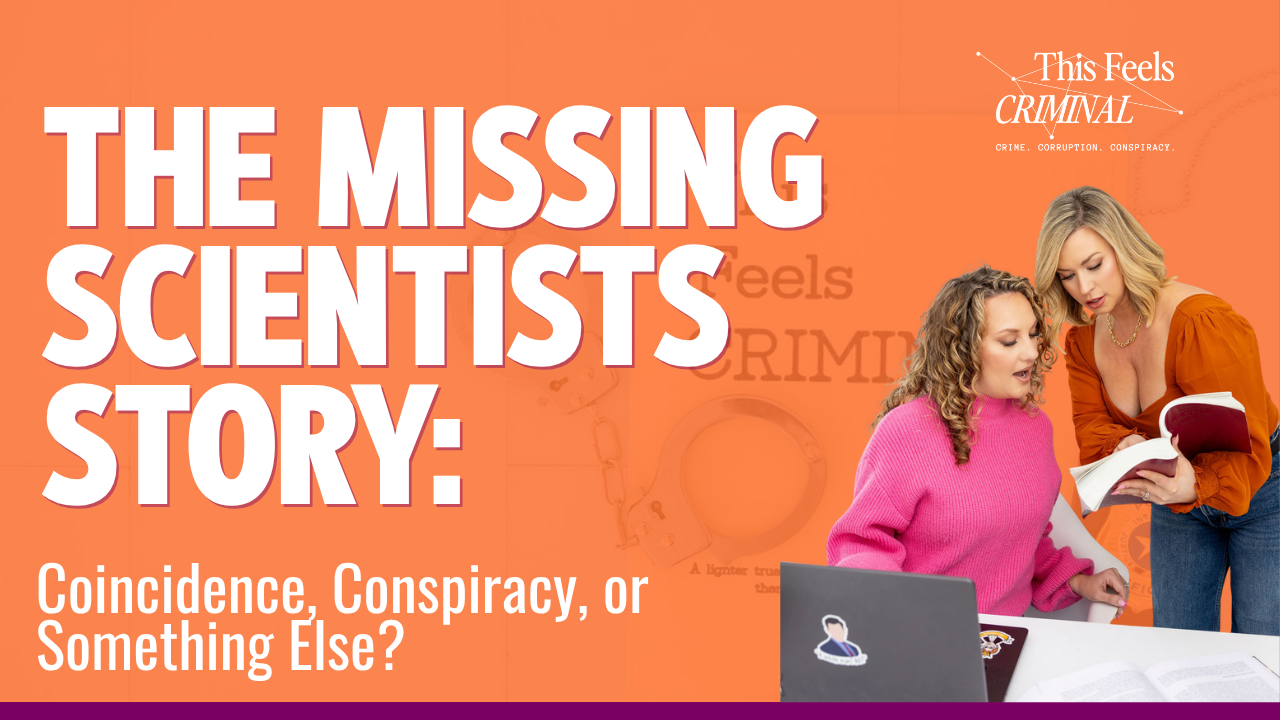
The Missing Scientists Story: Coincidence, Conspiracy, or Something Else?
Explore this Episode
- Listen to the Full Episode
- Watch the Show on YouTube
- In these episodes, we break down:
- How the “Missing Scientists” Theory Started
- The Cases People Keep Connecting
- The Part of the Story That Feels the Most Unsettling
- Are the Cases Actually Connected?
- The Bigger Question Nobody Can Ignore
- Listen to the Full Episode
- Frequently Asked Questions about the Missing Scientists
A scientist disappears during a hike.
A retired Air Force general walks out of his house and vanishes.
A renowned astrophysicist is shot on his own front porch.
And somewhere between TikTok conspiracy threads, Substack posts, cable news segments, and White House briefings… the internet became convinced these cases were connected.
Now the FBI is investigating.
But are these deaths and disappearances actually linked?
Or are people seeing patterns where none exist?
That’s the question at the center of this week’s This Feels Criminal episode.
Listen to the Full Episode
Prefer to listen to the full story? We go deeper into the timelines, the investigations, and the details that don’t quite add up in this episode of This Feels Criminal.
Tune into Episode 1 here:
Tune into Episode 2 here:
Watch the Show on YouTube
Prefer to watch your podcasts on YouTube? We’ve got you! You will find both episodes combined into 1 video on YouTube!
In these episodes, we break down:
- The disappearances and deaths that sparked a federal investigation
- Why people online became convinced these cases were connected
- The scientists, researchers, and officials at the center of the story
- The details that made certain cases spiral across the internet
- What the FBI, Congress, and the White House have actually said
- The psychology behind conspiracy theories and pattern recognition
- How this story exploded from Substack posts to national headlines
- And the bigger question underneath all of it: when does coincidence start to feel like conspiracy?
How the “Missing Scientists” Theory Started
The story exploded online in early 2026 after several deaths and disappearances involving scientists, engineers, and researchers connected to aerospace, nuclear, and defense work began circulating together online.
The names spanned multiple states, multiple institutions, and wildly different circumstances:
- Missing hikers
- Confirmed homicides
- Reported suicides
- Fatal accidents
- Unexplained disappearances
Then came the federal response.
The FBI publicly confirmed it was investigating possible connections between the cases, while the House Oversight Committee and White House also acknowledged the growing public concern.
And that’s when the story went fully mainstream.
The Cases People Keep Connecting
Some of the names attached to the theory include:
- Monica Reza, a NASA materials scientist who disappeared during a hike in California
- William Neil McCasland, a retired Air Force Major General who vanished from Albuquerque
- Amy Eskridge, a physicist whose death has become one of the most debated cases online
- Carl Grillmair, a Caltech astrophysicist killed outside his home
- Nuno Loureiro, an MIT fusion researcher killed in Massachusetts
Online communities quickly began connecting the dots between them, especially because several had ties to aerospace research, nuclear technology, or government projects.
But not everyone agrees those connections actually mean anything.
The Part of the Story That Feels the Most Unsettling
One of the strangest details in the entire story is how quickly it spread.
What started as online speculation moved from fringe internet spaces to mainstream media coverage in a matter of weeks.
Then politicians began referencing it publicly.
Then cable news picked it up.
Then federal agencies responded.
And suddenly, a theory that most people had never heard of became the subject of an active federal probe.
That shift, from internet theory to official investigation, is one of the biggest questions we unpack in the episode.
Are the Cases Actually Connected?
That depends on who you ask.
Some researchers and skeptics argue this is a classic case of apophenia, the human tendency to see meaningful patterns in unrelated events.
Others point to the similarities between certain cases and argue there are still too many unanswered questions to dismiss completely.
Even many of the families connected to the cases have publicly rejected the conspiracy framing and asked people to stop grouping their loved ones into online theories.
And honestly… that’s part of what makes this story so complicated.
The Bigger Question Nobody Can Ignore
The most unsettling part of this story may not be whether the deaths are connected.
It may be how quickly the internet can push a narrative from social media speculation into a federal investigation.
Because once a story reaches that level, the investigation itself becomes proof to people who already believe it.
And that’s where things get messy.
Listen to the Full Episode
We are breaking it down in a two-part episode of This Feels Criminal. We cover:
- The timeline of every major case
- What’s confirmed vs what’s speculation
- Why some families are speaking out
- The “missing scientists” conspiracy theory
- The FBI investigation and White House response
- The psychology of pattern recognition and apophenia
- And the bigger systems question underneath all of it
Frequently Asked Questions about the Missing Scientists
The theory claims that multiple scientists, engineers, and researchers connected to aerospace, nuclear, or defense work may have died or disappeared under suspicious circumstances. The story gained national attention in 2026 after federal agencies acknowledged they were reviewing possible connections between several cases.
Yes. The FBI publicly confirmed it is investigating possible links between several deaths and disappearances connected to the story.
Monica Reza was a NASA materials scientist who disappeared while hiking in California in June 2025. Her disappearance became one of the most discussed cases connected to the theory.
William Neil McCasland is a retired Air Force Major General who disappeared from his Albuquerque home in February 2026. His previous connection to Wright-Patterson Air Force Base fueled online speculation about the case.
Apophenia is the tendency for the human brain to perceive meaningful patterns between unrelated events. Skeptics of the conspiracy theory argue that this may explain why people believe the cases are connected.
Some of the cases have known explanations or active suspects, while others remain unsolved or open investigations. Several families involved have publicly rejected conspiracy theories surrounding their loved ones.
Critics argue that when dealing with large populations of scientists, researchers, and government workers, unrelated deaths and disappearances can appear connected even when they are statistically expected.